

How hardy are Japanese banana plants really, and can I get away with leaving mine unprotected in a Hertfordshire winter?
There comes a point in autumn when every gardener with a big Musa basjoo, the Japanese hardy banana, faces the same dilemma: do you wrap it up for winter, or take a risk and let nature do its thing?
My Musa basjoos are now around 10ft tall, and after all the effort of getting them to this size, the thought of losing those impressive stems over winter isn’t particularly appealing. But Musa basjoo has a reputation for being one of the hardiest banana plants you can grow in the UK. So, just how much protection does it really need?
Could I leave mine completely unwrapped and see what happens, or would that be tempting fate a little too much?
Let’s look at what the cold actually does to the leaves, stems and roots, what a typical Hertfordshire winter might throw at them, and whether protecting these giants is really worth the effort.
How hardy is Musa basjoo?
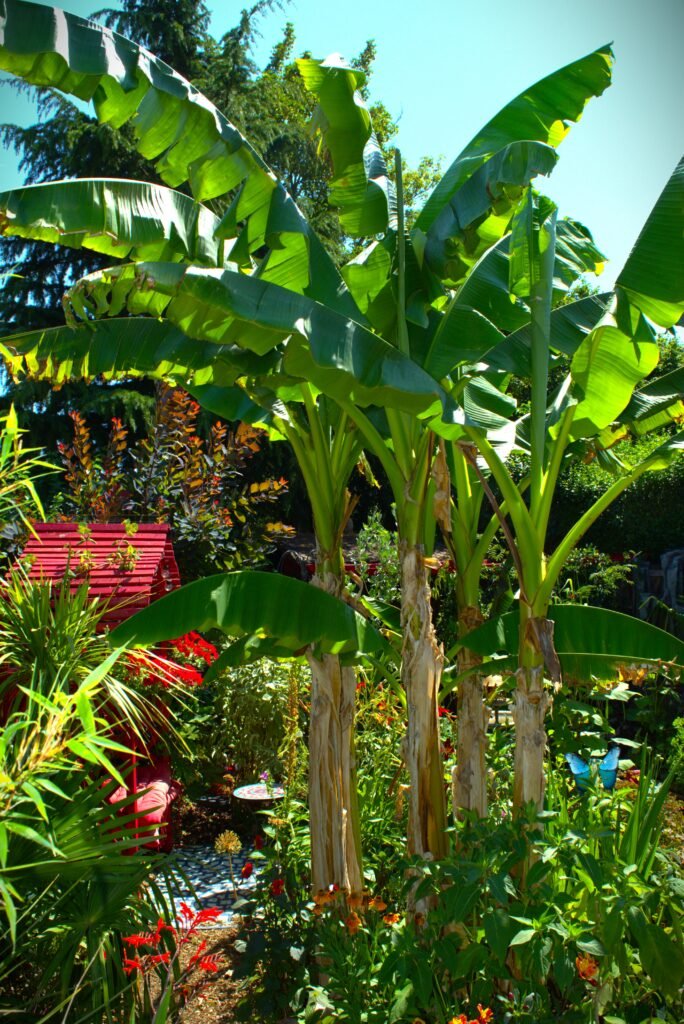
Musa basjoo is often described as a hardy banana, and compared with most tropical-looking banana plants, it certainly earns that reputation. It can survive outdoors in many parts of the UK, including colder inland gardens, provided it has suitable growing conditions.
However, there’s an important distinction between a banana plant surviving winter and retaining its full height.
Hardy doesn’t necessarily mean evergreen, frost-proof or guaranteed to survive every winter without protection.
Musa basjoo grows from an underground rhizome, which is the part of the plant that matters most for its long-term survival. Even if the foliage disappears and the tall stems are badly damaged, a healthy rhizome may survive underground and send up new growth when warmer weather returns.
The real question is how much of the plant you want to preserve.
- Want it to survive? Keeping the roots and rhizome alive is the priority.
- Want it to return quickly in spring? Protecting the base and underground growth can make a big difference.
- Want those impressive 10ft stems to remain standing? You’ll need to give the stems considerably more protection than the roots alone.
For me, losing a few leaves is one thing. Losing several feet of established stem growth is another.
What happens to the leaves when temperatures drop?
The leaves are the first part of Musa basjoo to suffer when autumn temperatures fall.
These enormous, tropical-looking leaves are not designed to withstand repeated British frosts. A light frost can leave them looking scorched, with darkened patches, torn edges and a generally miserable appearance.
As temperatures fall further, the leaves can turn brown, collapse and eventually become little more than soggy remnants hanging from the plant.
This is completely normal.
Once frost damage has set in, wrapping the leaves won’t reverse it. Their job is largely done for the season anyway, and most gardeners accept that the foliage will die back in winter.
The good news is that damaged leaves don’t automatically mean the whole plant is in trouble. If the rhizome and growing point remain healthy, fresh leaves can emerge during the following growing season.
In other words, the leaves are expendable; the growing point and rhizome are what really matter.
And with plants standing 10ft tall, protecting every leaf would be an enormous undertaking with very little benefit.
What about the stems? This is where it gets interesting.
The stems, or more accurately the pseudostems, are the tall structures that give Musa basjoo its impressive height. They are made from tightly packed leaf bases rather than a conventional woody trunk.
These are the parts I would be most reluctant to lose.
Musa basjoo can retain some of its pseudostem through winter, allowing it to start the next growing season from a much greater height. That means a plant that survives with its stems intact can get off to a much quicker start than one that has to grow again from ground level.
Unfortunately, the stems are more vulnerable to cold than the underground rhizome.
As frost becomes more severe, the outer layers can suffer damage, and prolonged freezing can damage the tissues inside. Once the pseudostem is badly frozen, it may soften, become waterlogged and rot.
The severity of the damage depends on several factors:
- How low the temperature falls.
- How long the plant remains frozen.
- Whether the stem is wet as well as cold.
- How exposed the garden is to wind.
- Whether the base and growing point have any insulation.
A brief, mild frost is very different from several nights of hard frost followed by freezing days.
This is why there is no single temperature at which every Musa basjoo stem will fail. The condition of the plant, its shelter and the duration of the cold all play a part.
With 10ft stems, I have a lot of height to protect. Wrapping them properly would take time, materials and a fair bit of patience. Leaving them exposed would certainly be the easier option, but it would also mean accepting that I might lose some, or even most, of that height.
And what about the roots?
This is where Musa basjoo earns its hardy reputation.
The underground rhizome is generally much better equipped to survive winter than the leaves or exposed pseudostems. The soil provides a degree of insulation, helping to buffer the rhizome against sudden temperature changes.
However, the roots are not invincible.
A prolonged cold spell can freeze the soil deeply, particularly in exposed gardens or where the plant is growing in wet, poorly drained ground. Waterlogged conditions also increase the risk of rot, while severe freezing can damage the rhizome itself.
The good news is that established plants growing in the ground usually have a better chance of surviving than plants in containers, where the root system is exposed to cold from all sides.
This is one reason why a mature Musa basjoo can sometimes look completely finished above ground in spring but still produce fresh shoots from the base.
If the underground rhizome survives, the plant can recover.
But recovery doesn’t necessarily mean a return to 10ft in the same season. Losing the established stems can mean starting again from much closer to ground level, which is a significant setback when you’ve spent years building up a mature specimen.
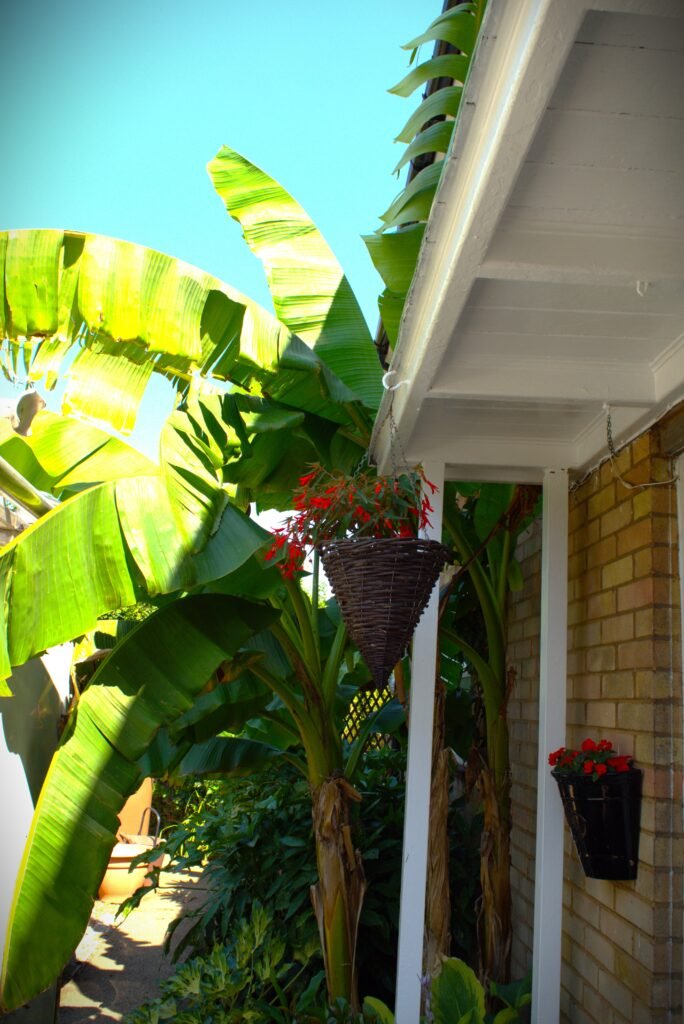
How cold can Musa basjoo tolerate?
It’s tempting to look for a definitive temperature chart, but hardiness figures should be treated as rough guides rather than guarantees. Different parts of the plant tolerate different conditions, and a short overnight frost is not the same as a sustained freeze.
Here is a practical way to think about the effects of winter temperatures.
| Winter conditions | What you might expect |
|---|---|
| Cool weather above freezing | Growth slows or stops; the plant prepares for dormancy. |
| Light frost, around 0 to -2°C | Leaves may become scorched or damaged; exposed stems may remain largely intact. |
| Moderate frost, around -3 to -5°C | Greater leaf damage; exposed pseudostems may begin to suffer, especially after repeated frosts. |
| Hard frost, around -5 to -8°C | Significant stem damage becomes increasingly likely, particularly with prolonged exposure. |
| Severe or prolonged freezing, below roughly -8°C | Serious damage to unprotected stems is possible; the rhizome may still survive if the soil provides sufficient insulation. |
These are illustrative ranges, not guaranteed damage thresholds. Wind exposure, moisture, the length of the cold spell and local conditions can shift the outcome considerably. A sheltered plant may fare better than one exposed to biting winds, while a long freeze can be more damaging than a brief dip to the same minimum.
The key point is that the underground rhizome can survive conditions that destroy the leaves and above-ground stems. Protecting the base is therefore often the best compromise if you don’t want to wrap the entire plant.